Acupuncture has long been recognized as a powerful therapeutic modality for promoting nervous system regulation, reducing pain, and supporting whole-person healing. While traditional needle acupuncture remains the most widely practiced form, advances in medical technology have introduced laser acupuncture as an effective, modern, non-invasive alternative.
Both approaches share the same foundational goal—stimulating acupuncture points to restore physiological balance—but differ in method, sensory experience, and clinical application. Understanding these differences helps patients make informed decisions and enables practitioners to tailor treatment strategies to individual needs.
Traditional Acupuncture: Mechanisms and Clinical Role
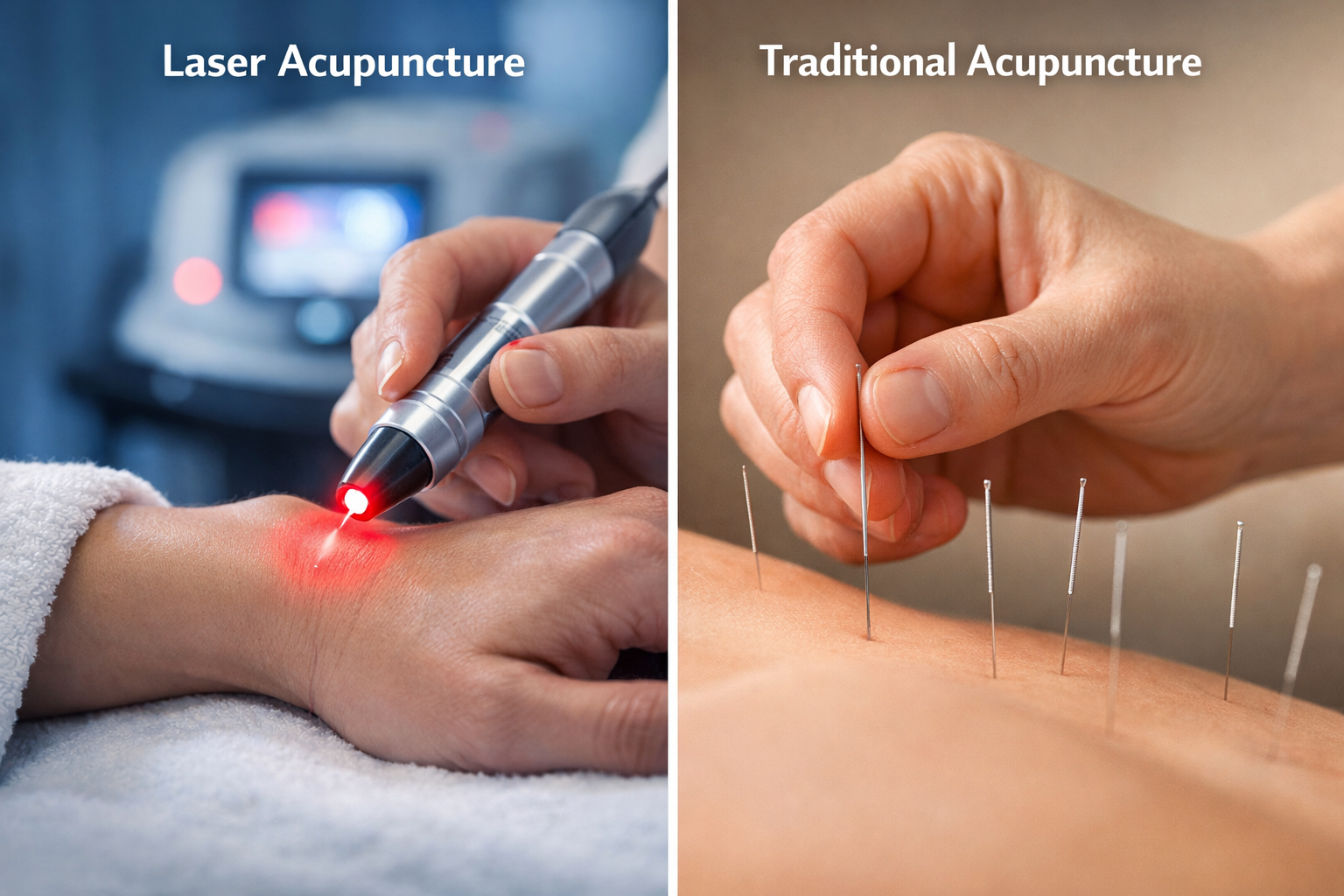
Traditional acupuncture involves inserting sterile, single-use filiform needles into specific acupuncture points to harmonize biological functioning through the regulation of the movement of qi and blood. Gentle manipulation of the needles may elicit deqi, a sensation associated with therapeutic activation. Mechanistically, needle acupuncture stimulates peripheral sensory nerves and connective tissue, triggering central nervous system modulation and endogenous opioid release. Connective tissue deformation around needles contributes to mechanotransduction effects that influence fibroblast activity and tissue remodeling. Functional imaging studies further demonstrate acupuncture’s capacity to regulate limbic and somatosensory brain regions involved in pain perception and emotional processing. Clinically, traditional acupuncture has strong evidence supporting its effectiveness in chronic pain, headaches, osteoarthritis, stress management, gastrointestinal, endocrinological and gynecological disorders.
Laser Acupuncture: Mechanisms and Emerging Evidence
Laser acupuncture stimulates acupuncture points using low-level laser light without skin penetration. This approach is grounded in photobiomodulation, where light energy influences cellular metabolism and inflammatory signaling. Photons absorbed by mitochondrial chromophores can enhance ATP production, regulate oxidative stress, and activate pathways involved in tissue repair. These effects contribute to the analgesic and anti-inflammatory outcomes documented in low-level laser therapy research. When applied to acupuncture points, laser stimulation can produce neuromodulatory responses comparable to needle acupuncture through photochemical mechanisms. Laser acupuncture shows promising clinical applications in pain management, neurological rehabilitation, wound healing, and pediatric care. Modern laser acupuncture systems, such as the PTL-II therapeutic laser, enable precise, multi-frequency stimulation of acupuncture points using red and near-infrared wavelengths, allowing the delivery of targeted photobiomodulation while maintaining acupuncture point specificity and treatment efficiency.
- Clinical advantages of PTL-II laser acupuncture may include:
- Non-invasive stimulation suitable for needle-averse patients
- Rapid treatment delivery with precise dosing parameters
- Enhanced neuromodulation and anti-inflammatory effects
- Potential integration with traditional acupuncture for hybrid treatment protocols
- Improved accessibility for pediatric, geriatric, and sensitive populations
Clinical Indications and Effectiveness
Research suggests that both traditional and laser acupuncture can be effective, though outcomes may vary depending upon the condition being treated. Traditional acupuncture has stronger evidence for musculoskeletal pain, migraines, osteoarthritis, and chronic pain syndromes. The depth and versatility of needle techniques allow for the address of complex, multi-layered conditions. Laser acupuncture has shown promise in pain management, wound healing, pediatric conditions, and neurological rehabilitation, particularly where gentle stimulation is preferred. Some studies suggest comparable outcomes between laser and needle acupuncture for certain pain conditions, though the evidence base for laser acupuncture is smaller and still evolving.
Evidence Snapshot
What research suggests about laser vs traditional acupuncture:
- Traditional acupuncture has strong evidence for chronic pain and musculoskeletal conditions
- Laser acupuncture demonstrates promising outcomes for pain, neurological conditions, and wound healing
- Both modalities influence nervous system regulation and inflammation
- Laser acupuncture offers a painless alternative for needle-sensitive patients
- Integrative use of both approaches may enhance personalization and adherence
Treatment Style, Frequency, and Customization
Traditional acupuncture sessions often involve retaining needles for 20–40 minutes, allowing sustained stimulation and the opportunity to treat multiple layers of imbalance simultaneously. Laser acupuncture treatments are typically shorter per point but may involve more precise dosing parameters, such as wavelength, power output, and exposure time. Treatment times can be as short as 15 minutes. In practice, the integration of both modalities in a hybrid approach, using laser acupuncture for sensitive points or patients and traditional needles where deeper or stronger stimulation is clinically indicated, allows for greater customization and patient-centered care.
Patient Experience and Comfort
One of the most noticeable differences between modalities is the treatment experience. Traditional acupuncture is generally well tolerated but may provoke anxiety in needle-sensitive individuals. Having said that, the overwhelming majority of people who present with concerns or anxiety about receiving a needle based treatment, experience little to no pain, aside from an occasional transient twinge at one or two points. Minor bruising or soreness can also occasionally occur. Laser acupuncture is entirely painless, non-invasive, and does not break the skin, making it particularly suitable for children, elderly patients, immunocompromised individuals, trauma-informed care settings, and individuals seeking gentle therapies. In contrast to traditional needling, it carries no risk of bleeding or bruising.
Practitioner Clinical Pearls
- Laser acupuncture can enhance compliance in needle-averse populations
- Needle acupuncture remains advantageous for myofascial pain requiring tissue engagement
- Laser acupuncture is useful in pediatric, geriatric, and immunocompromised populations
- Combining modalities enables layered stimulation across tissue depth and sensitivity
- Photobiomodulation effects may complement acupuncture’s neuromodulatory mechanisms
Traditional vs Laser Acupuncture Head to Head
| Feature | Traditional Acupuncture | Laser Acupuncture |
|---|---|---|
| Method | Needle insertion | Light stimulation |
| Sensation | Mild ache, tingling | Painless |
| Mechanism | Mechanical + neurophysiologic | Photobiomodulation |
| Evidence base | Extensive | Growing |
| Ideal patients | Chronic pain, complex patterns | Needle-averse, pediatrics |
| Risks | Minimal bruising possible | Minimal, requires eye safety |
| Treatment time | Needle retention 20–40 min | Shorter treatment, as little as 15 min |
| Integration potential | High | High |
Safety and Scope Considerations
Both traditional and laser acupuncture are generally considered safe when performed by trained, licensed practitioners. Traditional acupuncture carries minimal risk, primarily related to transient discomfort, improper technique or minor issues with bleeding or bruising. Laser acupuncture requires appropriate training in laser safety, including eye protection and correct dosing, to avoid misuse. As a class IIIA laser, the PTL-II platform minimizes patient and practitioner risk when safety instruction compliance is observed.
Importantly, neither modality should be viewed as a replacement for necessary medical care. Acupuncture—whether laser or needle-based—is best understood as a complementary therapy within an integrative healthcare model.
Choosing the Right Approach
Choosing between laser and traditional acupuncture depends on patient preference, clinical presentation, and therapeutic goals. Traditional acupuncture offers versatility and deep tissue engagement, while laser acupuncture provides comfort, precision, and accessibility through a non-invasive, gentler acupoint stimulation.
For many patients, a combined approach offers the greatest benefit, allowing practitioners to tailor stimulation intensity and modality based on individual sensitivity and treatment objectives.
Curious which approach is right for you?
Whether you prefer traditional acupuncture, laser acupuncture, or a personalized combination of both, integrative care can be tailored to your comfort level and clinical needs.
Schedule a consultation to explore your options and receive a customized treatment plan designed for your health goals.
This article is intended for educational and informational purposes only and does not constitute medical advice. Individual treatment outcomes may vary. Acupuncture and laser acupuncture services are provided within Florida licensure guidelines and are designed to complement conventional medical care rather than replace it.
References
-
Zhao, Z. Q. (2008). Neural mechanism underlying acupuncture analgesia. Progress in Neurobiology, 85(4), 355–375.
-
Langevin, H. M., Churchill, D. L., & Cipolla, M. J. (2001). Mechanical signaling through connective tissue. FASEB Journal, 15(12), 2275–2282.
-
Hui, K. K. S., Liu, J., Makris, N., et al. (2005). Acupuncture modulates limbic system activity. Human Brain Mapping, 9(1), 13–25.
-
Vickers, A. J., Vertosick, E. A., Lewith, G., et al. (2018). Acupuncture for chronic pain. Journal of Pain, 19(5), 455–474.
-
de Freitas, L. F., & Hamblin, M. R. (2016). Photobiomodulation therapy. IEEE Journal of Selected Topics in Quantum Electronics, 22(3), 7000417.
-
Chow, R. T., Johnson, M. I., Lopes-Martins, R. Á., & Bjordal, J. M. (2009). Laser therapy in pain management. The Lancet, 374(9705), 1897–1908.
-
Hamblin, M. R. (2017). Photobiomodulation mechanisms. AIMS Biophysics, 4(3), 337–361.
-
Whittaker, P. (2019). Laser acupuncture. Medical Acupuncture, 31(6), 331–338.
-
Baxter, G. D., Bleakley, C., & McDonough, S. (2017). Laser acupuncture effectiveness. Journal of Acupuncture and Meridian Studies, 10(1), 1–12.