

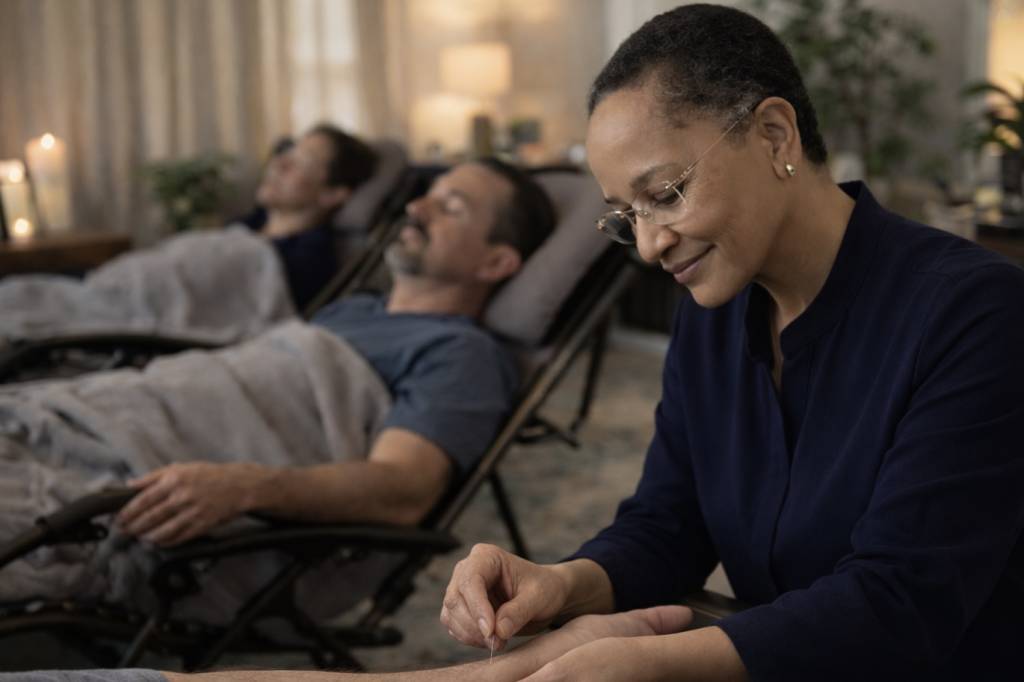
Community acupuncture is a care model designed to make the ancient healing practice of acupuncture more accessible, affordable, and integral to everyday life. While it is rooted in the same theoretical foundations as traditional acupuncture, this modern adaptation differs significantly in its setting, delivery, and philosophy of care. By emphasizing group treatment, low cost, and consistent access, it has emerged as a public-health–oriented approach that broadens the reach of acupuncture beyond those who can afford private, one-on-one sessions.
Although acupuncture has been practiced for thousands of years in East Asia, the modern community acupuncture movement is relatively recent, pioneered by Lisa Rohleder and Skip Van Meterto in Portland, Oregon in the early 2000s. Practitioners sought to address the gap between acupuncture’s proven benefits and its limited accessibility due to high costs for individualized treatment models. Inspired in part by public health principles and by historical examples of group-based medicine, such as China’s “barefoot doctors,” early community acupuncture clinics experimented with high-volume, low-cost care. The success of these clinics led to the formation of advocacy and educational organizations that promoted community acupuncture as a distinct model rather than a compromise in quality. Today, this clinic model can be found in urban and rural areas alike, often serving as vital healthcare resources within their communities.
The Unique Design
The defining feature of community acupuncture is its clinical design. Treatments are provided in a shared, open room where multiple patients receive acupuncture simultaneously. Patients are typically seated in reclining chairs rather than lying on individual treatment tables. This setup allows practitioners to treat several people at once, greatly reducing overhead costs and enabling charging lower fees. Treatments are offered at either a fixed reduced fee or on a sliding-scale payment system. Patients pay what they can within a stated range, without providing proof of income or justification. This model emphasizes trust, dignity, and inclusivity. By removing financial barriers and insurance complexity, clinics encourage frequent and ongoing care, which is often essential for chronic or stress-related conditions. When offering sessions in the community setting, practitioners tend to focus on distal acupuncture points—commonly on the arms, legs, head, and ears—so patients can remain clothed and comfortable in a shared space. While the environment is social, it is also intentionally calm and respectful, with an emphasis on quiet, rest, and collective healing.
Benefits of Community Acupuncture
One of the primary benefits of this treatment model is accessibility. Lower costs make acupuncture available to people who might otherwise never consider it, including those without insurance, people on fixed incomes, or individuals facing long-term health challenges. This affordability also allows patients to receive treatments more frequently, which can improve outcomes for conditions such as chronic pain, anxiety, depression, migraines, and insomnia.
Another key benefit is the normalization of care. The community acupuncture philosophy treats acupuncture not as a luxury or occasional indulgence, but as regular health maintenance—similar to exercise or counseling. This shift helps integrate acupuncture into mainstream wellness and preventive care. The communal aspect itself can also be therapeutic. Many patients report that receiving treatment alongside others fosters a sense of shared humanity and mutual support. While there is minimal interaction during sessions, the awareness that others are resting and healing nearby can reduce feelings of isolation often associated with illness or stress. From a public health perspective, this treatment design offers an efficient way to deliver non-pharmacological pain management and stress reduction. At a time when healthcare systems are strained and concerns about medication overuse persist, community acupuncture provides a low-risk, cost-effective complement to conventional care.
Community Acupuncture vs Traditional Acupuncture Sessions
Traditional acupuncture sessions typically take place in private treatment rooms, with one practitioner treating one patient at a time. These sessions often last longer and involve more extensive intake discussions, individualized point selection, and sometimes additional modalities such as cupping, moxibustion, or herbal consultations. Fees are correspondingly higher, reflecting the extended one-on-one time and multimodal therapies. Community acupuncture, by contrast, prioritizes efficiency and collective care. While treatments are still individualized in terms of point selection and clinical intent, the scope is often more focused. Practitioners aim to address the main complaint or pattern rather than conducting an exhaustive session each visit. This streamlined approach supports frequent treatments, which can be particularly effective over time.
Privacy is another key distinction. In the communal setting, personal health conversations are kept brief and discreet, often occurring before or after treatment rather than during it. Patients who prefer extensive discussion or complete physical privacy may feel more comfortable in traditional settings, whereas others value the simplicity and reduced pressure of the community model.
Treatments in the community model can address the same concerns often seen in the traditional setting, including pain management, stress, digestive and immune support, sleep disturbances, and emotional balance with equal efficacy. This treatment dynamic is neither inherently less effective nor less skilled. It represents a different philosophy of care—one that emphasizes population health, sustainability, and access rather than exclusivity and customization.
Embracing Modern Medical Care Constraints
Community acupuncture reimagines how acupuncture can function within modern healthcare. By redesigning the clinical environment, lowering costs, and embracing a collective model, it expands access to a time-honored healing practice while maintaining its therapeutic integrity. Distinct from traditional private sessions, community acupuncture offers an inclusive, efficient, and socially conscious approach that aligns individual healing with community well-being.